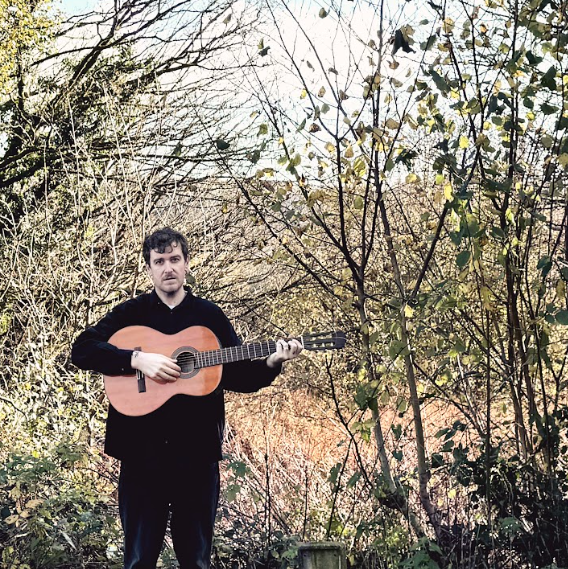
Del Osei-Owusu sits down with artists on the FOTN radar and gets them to tell their origin story over a cup of tea and biscuits. This week, a murphy is in the hotseat and he brought custard creams.
Hello Andrew, how are you?
I’m well, thank you, though my wife and I recently had our first child so I am also extremely exhausted and fairly consistently petrified.
You’re an artist from Wales: how did it all begin for you?
I’m not from Wales originally; I grew up in Shropshire, so that is where I started learning music, first on piano and then saxophone, which I played in the local youth orchestra and jazz bands there.
I was probably about 12 when I first picked up the guitar, which is my main instrument now. My parents both played, so I’m not sure why it took me until then, but, knowing nothing, I remember finding an open tuning and starting to explore. I am self-taught, so am probably not much further along in my education than I was then, but there are probably benefits to having found my own path with how to play the instrument.
What did you listen to growing up?
My mum was a real fan of R.E.M., so that is probably the band I have strongest memories of listening to when I was young, alongside anything that found its way onto Top of the Pops in the 90s.
Congratulations on the release of ‘haunt’: how does it feel?
Thank you. I realised quite quickly I was rather naive in thinking this would be a good time to release an album, but I’m really pleased to have it out and grateful that people have enjoyed listening to it. I probably finished recording it around this time last year, so at the same time it already feels very familiar to me and it is easy to forget it has only just been released.
It’s an eight-track album: what’s your favourite track from it?
I think ‘hymnal’ has really been my favourite track from the moment I started playing around with it, and having started performing the album in front of people it is the one I most enjoy playing.
What’s your favourite memory of recording it?
My favourite part of recording any piece is always when I begin fleshing it out, in the case of this album with horns and wind instruments; that is when it feels to me as though it becomes less of an idea and more a piece of music. That said, it can also be the time when I realise something isn’t going to work, which is quite disheartening when so much effort has already gone into a piece that is ultimately going to come to nothing.
You recorded it at home in Wales: what made you choose to do that?
I have recorded in studios before, but I much prefer the freedom of working on my own, to my own schedule, and being able to fully relax when I’m putting something together. There is no real pressure, so I am able to make mistakes, which I do very often, and nobody is waiting on me to get something finished by the end of a session. I do often invite collaboration later in the process, but I like being able to craft the general sound I want before presenting it to anybody else.
What was the easiest and most challenging part of recording the album?
The easiest part, unusually, was writing it. I was a bit lost trying to write for a different project, and wondered whether I really wanted to continue making music at all, when these songs started coming out. I think, again, having taken the pressure off myself, and not being constrained by any style or the spectre of previous works, meant I was able to write freely and just see what happened.
The most challenging aspect was probably actually finishing it and deciding to have a go again at releasing it. Having come to terms almost with not releasing any more music, it wasn’t easy to decide to do so with this album, especially as a debut under my own name, or at least a version of it.
You worked with your longtime friend Iain Berryman on it: what did you learn from him?
I first played music with Iain and his brothers in the local youth orchestra more than 20 years ago, and have been in numerous groups with him since, so he and especially his brother Davy have shaped what I do and the way I do it immeasurably.
Probably the most sage advice he has given me in recent years is to keep releasing music for myself. I have never clamoured after anything other than enjoyment from what I create, but it is nevertheless very easy to be guided by what I feel people might want to hear from me, all the while straying from what I really want to make. I think the thing of which I am most proud when it comes to ‘haunt’ is that it really reflects me as a writer and musician.
Do you two have a routine while recording?
It has varied over the years, but for this album Iain mixed and mastered it in LA, where he moved from London last year, so I sent him all the parts I had recorded and he worked on it from there. After all this time, it is fair to say we have a good understanding of each other as musicians, so a lot of the time the first reference tracks he sends back are what end up being the finished article. He is an incredibly talented musician, engineer and producer, so I am very lucky to be able to work with him as well as call him a friend.
What are you listening to at the moment?
Being able to sit down and listen to a record has been somewhat of a rarity for me this year, but I did find half an hour to do so this evening, so the last thing I listened to was Gal Costa and Caetano Veloso’s ‘Domingo’. I also recently bought some cassettes from Death Is Not The End, and I have particularly enjoyed listening to their archival compilations of Phleng Thai Sakon and Begena music. In terms of more recent releases I have really enjoyed Dagmar Zuniga’s ‘in filth your mystery is a kingdom’ and ‘Tragic Magic’ by Julianna Barwick and Mary Lattimore.
What are you looking forward to doing next?
I have really enjoyed playing in front of people again, and I do plan on venturing further afield than South Wales to do so when I feel comfortable leaving my family overnight, but I have also continued writing music since finishing ‘haunt’, so I would like to find time over the coming months to record some of that and see how I feel about releasing it. Finding that time will certainly be easier said than done, however.