
EKTA SAHA, Lead Content Marketer at WIINGY provides a step by step breakdown for a weekly routine for musicians.
You have songs. You just don’t have a system. Here’s one that works.
You didn’t pursue music to turn it into a system. But somewhere between writing songs, recording, posting on Instagram, pitching playlists, building a mailing list, and trying not to burn out – you have realised that lack of planning doesn’t quite work.
Here’s the uncomfortable truth: the indie artists that are gaining ground these days are not necessarily better than you. They’re more consistent – not in a hustle-every-day sense, but in the sense of having a routine to follow.
Because the problem isn’t effort, it’s randomness. A simple weekly routine fixes that. It gives your music a rhythm beyond inspiration – making sure you’re not just creating, but also improving, sharing, and getting heard.
The state of indie music right now (it’s actually good news)
The independent music sector is thriving right now. In the first half of 2024, over 62% of artists hitting between 1M and 10M U.S. streams were independent – no major label backing. Moreover, indie music revenues grew by 16.1% last year, outpacing the overall industry growth of 9%.
On paper, things have never looked better. It’s easier than ever to release music, record from home, and reach listeners across the world. But access alone doesn’t guarantee momentum.
With thousands of new tracks dropping every day, standing out is harder than it sounds. Most artists are juggling five or more social platforms, often without a clear direction on any of them.
And that’s where things start to fall apart. The issue usually isn’t talent or even resources – it’s scattered effort.
What actually helps is structure. A simple, consistent weekly routine doesn’t mean doing more – it means focusing on what matters and making sure it actually gets done.
The core principle
Independent artists need to run their music career like a small business. Each release is a new product drop.
That sounds clinical, but it’s actually liberating. It means your week has shape. You know what Monday is for and what Friday is for. You’re not staring at a blank screen wondering if you should be writing, or recording, or posting, or emailing.
Here’s how to build that shape.
The weekly routine: A day-by-day breakdown
This isn’t a rigid corporate schedule. Think of it as a loose weekly rhythm – a default plan that you bend around gigs, studio sessions, and life. The goal is that each of the 5 key pillars of an indie music career gets deliberate attention every single week.
Those five pillars are:
1. Creating (writing and recording)
2. Releasing (finishing and distributing)
3. Marketing (social content, visibility)
4. Connecting (fans, community, industry)
5. Reviewing (analytics, learning, planning)
Here’s how you can map to a week:
Monday – Create without an agenda
Monday is your creative day. No phone, no analytics dashboard, no pressure to post. Just writing.
This doesn’t mean finishing a song. It means showing up and creating raw material – lyrics, voice memos, chord progressions, melodic hooks, even just a free-written journal entry about what you’re feeling. Not every session produces gold, but the sessions compound.
A good routine doesn’t force consistency, it creates conditions for it. Monday is your condition. You’re telling your brain: this is when we make things.
Time required: 1-3 hours of protected, distraction-free time.
Practical tip: Keep a single running document (or notes app) of lyric fragments, images, and titles. Mine it on Mondays.
Tuesday – Record and produce
Tuesday takes whatever Monday generated and starts shaping it. This might mean demoing a new idea, refining an existing track, or finishing a production you’ve been sitting on.
The key shift here: Tuesday is about output, not perfection. The goal is a rough demo or a meaningful step forward, not a finished master.
One of the best ways to be productive and avoid stress is to be an efficient planner. If you stick to a consistent work schedule, you’ll get more things done and find that you have more time to relax.
The other trap on Tuesday is working in a vacuum for too long. The longer you sit alone with a track, the harder it becomes to hear it clearly, every decision starts to feel equally valid or equally terrible. Getting a second opinion early, before you’ve over-invested, saves real time.
Wiingy works well here: it connects you with music producers and coaches for one-on-one lessons built around targeted feedback on your actual work – not generic advice, but specific notes on what’s landing and what isn’t. A single honest conversation about a Tuesday demo can redirect a track that might otherwise stall for weeks.
Time required: 2-4 hours in your DAW.
Practical tip: Export a rough demo at the end of every session, even if it’s incomplete. These become your content library.
Wednesday – Create content (not just posts)
Wednesday is marketing day, but not the kind where you stare at your phone wondering what to post.
You’re going to batch your content. Spend 1-2 hours creating the week’s social material in one sitting. This might include:
•A 30-second clip of something you recorded Tuesday
•A “how this song started” voice note or caption
•A poll asking fans to choose between two titles or cover directions
•A behind-the-scenes photo from your setup
•A short text post sharing what you’ve been listening to
Spotify data indicates artists who maintain consistent social posting schedules – 3 to 5 posts weekly, for eight weeks post-release generate 35% more streams than those who taper off promotion after two weeks.
The mistake most hobbyist musicians make is posting about releases only when releases happen. The artists gaining ground are posting consistently all the time, building audience familiarity week by week.
If you can’t manage three posts per week, start with one per week consistently for a year instead of sporadic posting. Consistency beats frequency. Always.
Time required: 1-2 hours of batching. Schedule posts for later in the week so you’re not thinking about it daily.
Platforms to prioritise: Pick two. Most hobbyist musicians do better going deep on one or two platforms than spreading thin across five.
Thursday – Fan connection and community
Thursday is for interactions.
This means:
• Replying to comments and DMs that came in earlier in the week
• Sending your email newsletter (even if it’s just 150 words)
• Engaging genuinely in music communities – forums, subreddits like r/WeAreTheMusicMakers, Discord servers, other artists’ comment sections
• Reaching out to one other independent musician for a potential collaboration, playlist swap, or just a genuine conversation
• Superfans represent just 2% of an artist’s listeners but generate 18% of streams and drive actual revenue through concerts and merchandise. Those people don’t materialise from algorithms. They come from consistent, personal connection.
• Your email list, in particular, is underrated at the hobbyist stage. Unlike social media followers – which platforms can deprioritise at any time, your mailing list is an audience you actually own. Email marketing consistently delivers the highest conversion rates, with average click-to-stream ratios of 27% compared to social media’s 8-12%.
• Even 50 people on a mailing list who genuinely care about your music is worth more than 5,000 passive followers who scroll past your posts.
Time required: 45-90 minutes.
Practical tip: Your newsletter doesn’t need to be professional. It can be one paragraph about what you’re working on, what inspired it, and what’s coming. Authenticity is the whole point.
Friday – Review, plan, and rest
Friday is the most underrated day in the routine.
Spend 30-45 minutes looking at what happened this week:
• Which social post got the most engagement? Why?
• Did you hit your creative goal for the week?
• What’s your next release, and how close is it?
• What’s one thing that felt like a drain versus one that felt energising?
Then plan the following week. Set your Monday creative focus. Decide what content you’ll batch on Wednesday. Set one goal for the week – just one.
Then stop. Let the weekend be genuinely off.
Long studio hours and lack of work-life balance amplify mental exhaustion. Other contributors include inconsistency in income, fear of losing relevance, and the need to manage multiple roles – artist, producer, business manager – all at once.
Burnout is not a badge of honour. It’s a career-ender. Protecting your weekends protects your music.
The monthly layer: The one thing that separates hobbyists from growing artists
On top of the weekly rhythm, add one monthly anchor:
One release or one significant update to your audience per month.
This doesn’t mean a full single every month – though that’s the ideal. Spotify recommends a new release every 4 to 6 weeks. But “release” can also mean:
• A polished demo shared only with your mailing list
• A cover version posted on YouTube
• A behind-the-scenes video of your process
• An acoustic version of something you’ve already released
Frequently putting out good music causes a snowball effect. The algorithms start to kick in. People start paying attention to you because you won’t go away. You’ll gain momentum.
Indie rapper Russ is the canonical example: he put out one song a week on SoundCloud for three years. Eventually, two of his songs reached the U.S. Billboard Hot 100, and he now has about 15 million monthly listeners on Spotify. The lesson isn’t to copy his cadence – it’s that sustained output compounds in ways that sporadic bursts never do.
Here’s how your weekly routine feeds into that monthly release cycle and how it snowballs over time:
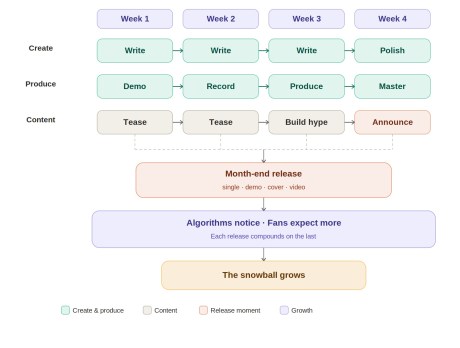
Notice that the release isn’t a separate thing you squeeze in – it emerges naturally from the weeks that preceded it. The writing, recording, and teasing all happened in real time. By release day, your audience has already been primed.
What to do if the routine breaks
Life happens. A week gets chaotic, you lose motivation, or the creative well feels empty.
Creative systems aren’t meant to stay fixed. What worked six months ago might not work now, and that’s normal. As your projects, energy, and priorities shift, your systems should evolve with them.
When you miss a week, don’t try to “catch up.” Just restart next Monday. The system only fails if you abandon it entirely.
And if you’re stuck creatively? When you feel burnt out, try to read, watch a movie or a tutorial to get more deeply into what you’re creating. Also, the space for dispersion – taking a break and spending time with your social networks helps. Sometimes the best thing you can do for your music on a Monday is go for a walk and listen to a record you love.
The real secret: Boring consistency beats brilliant bursts
The musicians who break through aren’t the ones who had one great month. They’re the ones who showed up every week for a year.
The indie music market is genuinely more accessible than it has ever been. The global indie music market is projected to reach $6.8 billion by 2027, growing at a compound annual growth rate of 8.2%. There is real room in it for you – but you have to be findable, and that means being consistent.
Structure isn’t the enemy of creativity. It’s what makes creativity sustainable. Pick a day. Start Monday. Protect the weekend. One week at a time.
The real secret: Boring consistency beats brilliant bursts
The musicians who break through aren’t the ones who had one great month. They’re the ones who showed up every week for a year.
The indie music market is genuinely more accessible than it has ever been. The global indie music market is projected to reach $6.8 billion by 2027, growing at a compound annual growth rate of 8.2%. There is real room in it for you – but you have to be findable, and that means being consistent.
Structure isn’t the enemy of creativity. It’s what makes creativity sustainable. Pick a day. Start Monday. Protect the weekend. One week at a time.