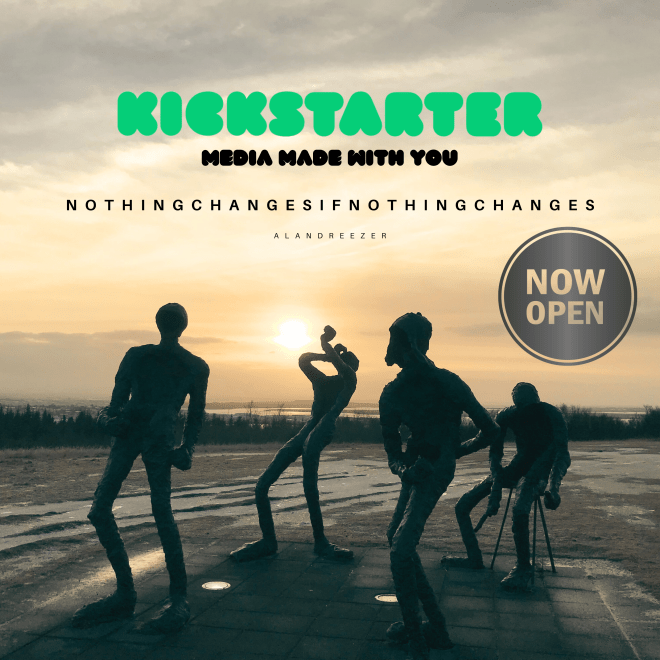
Building a Kickstarter in 2026: Fear, Faith, and the Reality of Independent Music by Alan Dreezer
Deciding to launch a Kickstarter campaign for a new album is equal parts excitement and quiet panic.
On paper, crowdfunding feels like a natural fit for an independent artist: no label, no safety net, just a direct connection between artist and audience. In reality, putting a campaign together forces you to confront some very real fears — not just about money, but about relevance, confidence, and whether you still truly understand your audience.
One of my biggest questions going into this campaign was a simple one: does my audience still
want physical media, or is streaming enough now?
Streaming is how most people consume music day-to-day, and I’m no exception. But albums — the objects — still mean something to me. CDs, vinyl, artwork, liner notes. They mark a moment in time. The worry is whether that feeling is shared widely enough anymore to justify offering physical rewards, or whether I’m clinging to something that’s quietly fading away.
Another fear was more personal: the fear of failure after making a lot of noise.
A Kickstarter launch isn’t subtle. You talk about it on social media, you email your mailing list, you ask people to share it. You step into the spotlight and say, “This matters to me.” If it doesn’t reach its target, that failure is very public. There’s no half-success on Kickstarter — it’s all or nothing. If the target isn’t reached, nobody is charged and nobody receives their rewards. That’s both reassuring and terrifying in equal measure.
I’ve been here before. In 2021 I ran a Kickstarter campaign for my album H E A L E D, and it did hit its target. But five years is a long time in the digital world. Social media algorithms have changed, people’s disposable income has changed, and attitudes towards crowdfunding may have shifted too. I couldn’t assume that what worked then would automatically work now.
What has changed in my favour is the infrastructure around independent releases.
Services like Elastic Stage and Teemill have completely reshaped how physical products can be offered. Instead of committing to large, expensive print runs and hoping they sell, I can now use print-on-demand. That means CDs, vinyl, clothing and merch can be produced individually as orders come in. It keeps prices realistic, reduces waste, and crucially lowers the financial risk of offering physical rewards at all.
Understanding what Kickstarter actually does is also important, because it’s often misunderstood.
Kickstarter isn’t a shop. It’s a platform that allows creators to pitch an idea and ask for support to make it happen. Backers aren’t “buying” products in the traditional sense — they’re supporting a project and receiving rewards as a thank-you. That distinction matters, especially when you’re setting expectations and explaining why funding is needed upfront.
Setting the target amount was one of the hardest parts of the entire process.
Because Kickstarter is all or nothing, the number has to be realistic but sufficient. Too low, and you risk not covering costs. Too high, and you risk the whole campaign failing. The target needs to account for production, manufacturing, platform fees, fulfilment, and a margin for the unexpected — because something always costs more than you think it will.
On the creative side, I feel confident.
I believe the artwork, logos, and visuals are strong, cohesive, and reflective of the music. The reward structure feels accessible too: from £6 for a digital album download, right through to a £100 bundle that includes vinyl, CD, a hoodie, and an artwork print. There’s a clear entry point for casual supporters, and something special for those who want to go deeper.
Ultimately, this campaign is about trust.
Trust that there are still people who value albums as complete works. Trust that my audience understands the realities of independent music. And trust that being honest — about fears, costs, and ambitions — is better than pretending confidence where none exists.
Launching a Kickstarter doesn’t eliminate uncertainty. If anything, it magnifies it. But it also creates something rare in modern music: a moment where the relationship between artist and listener is direct, transparent, and human.
And that, regardless of the outcome, feels worth the risk.